New Patient? Complete your intake form online before your visit and save time at check-in. Complete Intake Form

Patient Guide · 5 min read · Sep 7, 2026

Buying Glasses Online:
What the Research Says You Should Know

Ordering eyeglasses from a phone or laptop is easier than ever. But easier isn't always the same as accurate — independent studies on online eyewear have found real, measurable gaps in fit and prescription quality. Here's what the research shows, and how to protect your vision no matter where you shop.

Convenience and Accuracy
Aren't Always the Same Thing

Optometric associations and consumer researchers have repeatedly tested eyewear ordered online against the same optical standards used in professional dispensing. The findings point to three recurring problem areas: measurement accuracy, quality control on the finished lenses, and the loss of a comprehensive eye health check that normally comes with an in-person visit.

Measurement Errors Pupillary distance and other fit measurements are difficult to self-measure precisely, and small errors can cause real, lasting discomfort.
Inconsistent Quality Control Independent testing has found a meaningful share of online orders fail impact-resistance or prescription-accuracy checks.
No Eye Health Check A pair of glasses only addresses how well you see — it says nothing about the health of your eyes.
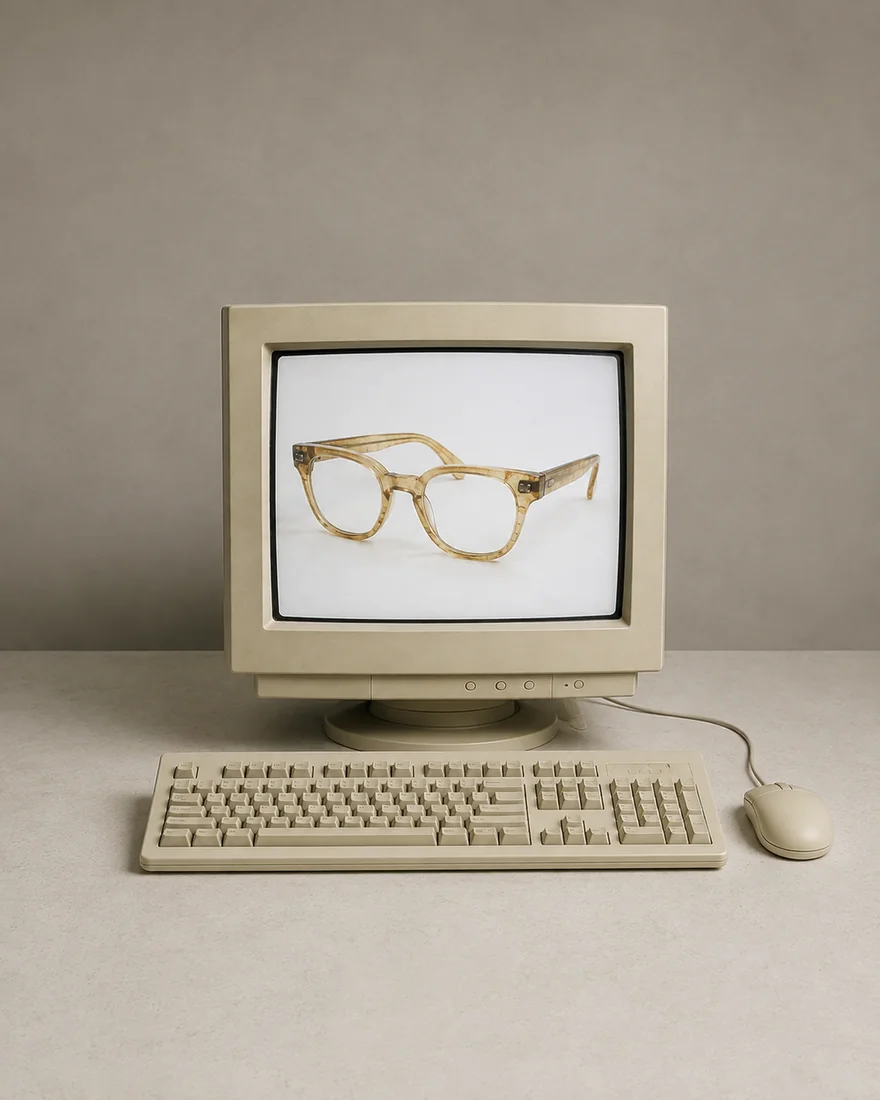
A pair of glasses displayed on an old CRT computer monitor, illustrating the gap between ordering eyewear online and an in-person fitting

What You Need to Know

The most widely cited independent look at this question is a national study commissioned by the American Optometric Association, which placed 200 orders with a range of online eyewear retailers. Only 154 of those orders were ever fulfilled and received. Of the pairs that did arrive, 44.8% either had an incorrect prescription or failed impact-resistance testing — the safety standard that determines whether a lens holds up if it's struck or dropped. Separately, 29% failed to meet the prescribed lens power in at least one eye, and impact-resistance failures showed up in 19% of adult lenses and 25% of children's lenses.

That study is older, and individual online retailers vary widely in how much they invest in quality control — some are considerably better than others. But the pattern hasn't disappeared: a more recent position statement from the UK's College of Optometrists cites research finding glasses purchased online were roughly twice as likely to fail optical tolerance testing as glasses dispensed in person, with a U.S. study it references finding 45% of online orders failed at least one optical quality measure. Taken together, the data suggests ordering glasses without an in-person fitting carries meaningfully more measurement risk than the alternative — not that every online order is unsafe.

Pupillary distance is the measurement, in millimeters, between the centers of your two pupils. It determines where the "optical center" of each lens sits — the exact point ground to match your prescription. Set correctly, light passes through the part of the lens engineered for it. Set even a couple of millimeters off, that same lens can introduce a subtle prism effect, causing eye strain, headaches, or a mild double-vision sensation that many people simply attribute to "getting used to new glasses."

Most online retailers ask customers to self-measure PD with a ruler, a credit-card-sized guide, or a phone app, or to pull it from an old prescription slip that may not list it at all. A trained optician measuring you with a pupillometer or corneal reflection device is working with a purpose-built instrument and repeated practice — a meaningfully more controlled process than a single self-measurement done at home with no way to check the result.

Single-vision lenses for a mild, stable prescription are the most forgiving category to order without an in-person fitting. Progressive and other multifocal lenses are a different story. Beyond pupillary distance, they require a seg height (where the near-vision portion of the lens sits relative to your pupil), an accurate read on vertex distance (how far the lens sits from your eye), and pantoscopic tilt (the frame's forward angle on your face) — all of which need to be measured while you're wearing the specific frame you've chosen, not estimated from a photo or a generic chart.

This is precisely where independent research has found the largest quality gap: the College of Optometrists' review found that progressive-lens wearers rated glasses dispensed in person meaningfully higher for fit and overall satisfaction than glasses ordered online. If your prescription includes a strong astigmatism correction, a large difference between your two eyes, or a multifocal add, that's the situation where a fitting error is most likely — and most noticeable once you're wearing the finished pair.

It's worth separating two things that often get bundled under the same errand: a refraction (the numbers describing how to correct your vision) and a comprehensive eye exam (a health evaluation of the eyes themselves). Ordering a pair of glasses — online or otherwise — only ever requires the first one. It tells you nothing about the second.

Conditions such as glaucoma, diabetic retinopathy, cataracts, and age-related macular degeneration are frequently symptom-free in their early, most treatable stages. They're typically caught through dilation, intraocular pressure testing, and retinal imaging — parts of a comprehensive exam that have nothing to do with picking a lens power. This isn't a criticism unique to online retailers; anyone who skips the health portion of an exam anywhere takes on the same risk. But a purchase that happens entirely online makes it easiest to skip that step altogether, since there's no exam chair to sit in and no doctor there to prompt a follow-up.

Getting It Right the First Time

A Properly Fitted Pair, Backed by a Comprehensive Exam

Whether you're due for a comprehensive eye exam or want a frame from our collection measured and adjusted in person — including lenses ground in our in-house lab in about an hour — our optometrists and opticians are here to help you get it right the first time.

Explore Our Eyewear Collection Book an Appointment