Patient Guide · 5 min read · Jan 5, 2026
Many patients are surprised by how much a thorough eye exam covers beyond "better one or two?" From retinal photography to glaucoma screening, here's exactly what happens during your visit at Visions Optique & Eyecare.
More Than a Vision Check
A comprehensive eye exam is a medical evaluation of the entire visual system and the health of your eyes — covering everything from your ability to read a smartphone screen to the condition of your retina. It is categorically different from a quick school screening or a vision-only check at a retail optical chain.
The Seven Steps
A walkthrough of every stage of a comprehensive eye exam at Visions Optique & Eyecare.
Your exam begins with a conversation. Your doctor reviews your personal and family medical history, current medications, previous eye conditions, and any current symptoms. Conditions like diabetes, hypertension, and autoimmune diseases have well-documented effects on eye health that directly inform the exam.
Using the familiar Snellen eye chart, your doctor measures how clearly you see at distance and near. This establishes your baseline and reveals whether a corrective prescription is needed or has changed.
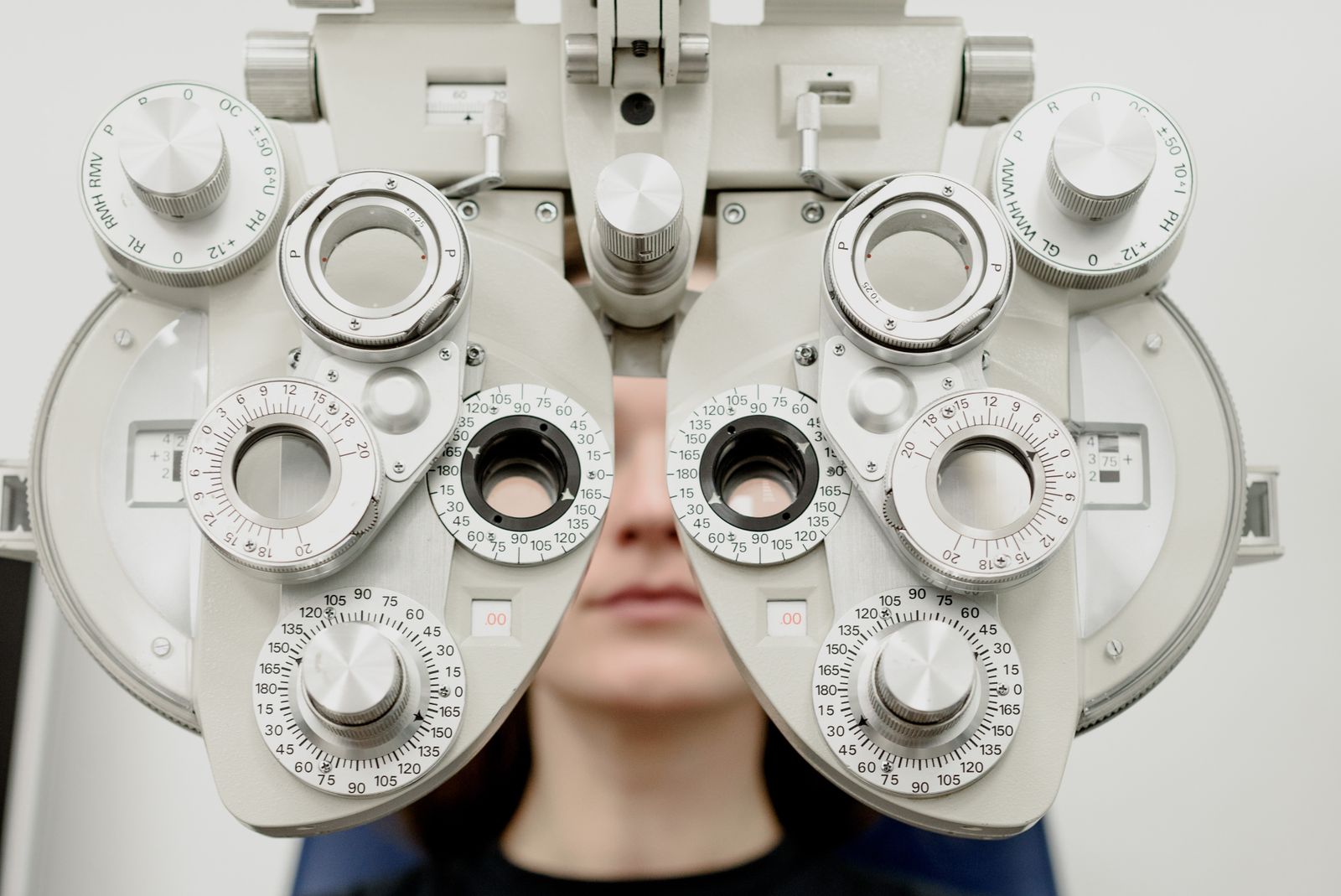
Refraction is the process of precisely determining your prescription. Using a phoropter — the instrument with interchangeable lenses — your doctor fine-tunes correction until you achieve your sharpest, most comfortable vision. This is the "better one or two?" sequence most patients recognize.
Your eyes must function as a coordinated team. Tests for eye tracking, convergence, and focusing flexibility assess how well they work together. Deficiencies here often cause reading difficulties and headaches that persist even with an accurate prescription.
A slit lamp is a high-magnification microscope that allows your doctor to examine the front structures of your eye in fine detail — the cornea, lens, iris, and eyelid margins. This is how cataracts, corneal irregularities, meibomian gland dysfunction, and early signs of dry eye are identified.
Advanced digital retinal photography gives your doctor a high-resolution image of your optic nerve, macula, and retinal blood vessels. Intraocular pressure is measured via non-contact tonometry (a brief puff of air) to screen for glaucoma. Dilation may be recommended for a wider view of the peripheral retina.
Your doctor explains all findings in plain language, reviews your prescription, answers questions, and outlines any recommended follow-up. A comprehensive exam at Visions Optique & Eyecare typically takes 20 to 30 minutes from check-in to checkout.
Put This Into Practice
Learn more about our comprehensive eye exams, or call or text us to schedule.