Sports Vision · 5 min read · Sep 15, 2026
Ask five golfers what lens color is best for the course and you'll likely get five different answers. There's real optical science behind why tint affects how a ball stands out against grass and sky — whether you're playing the open desert vistas at Desert Highlands or navigating the water features at Grayhawk. The honest answer is that it depends on the light you're playing in, and no single tint is correct for everyone.
Contrast, Color, and the Course
Every tint works by filtering out certain wavelengths of light more than others, which changes both the color balance you see and the contrast between objects of different colors. On a golf course, that means the same technology that makes a lens look "warm" or "cool" also changes how easily a bright ball stands out against green grass or a hazy sky. None of this replaces a comprehensive eye exam, but understanding the trade-offs can help you choose eyewear that actually suits your game, whether your home course is Troon, DC Ranch, or another club around North Scottsdale.
In This Article
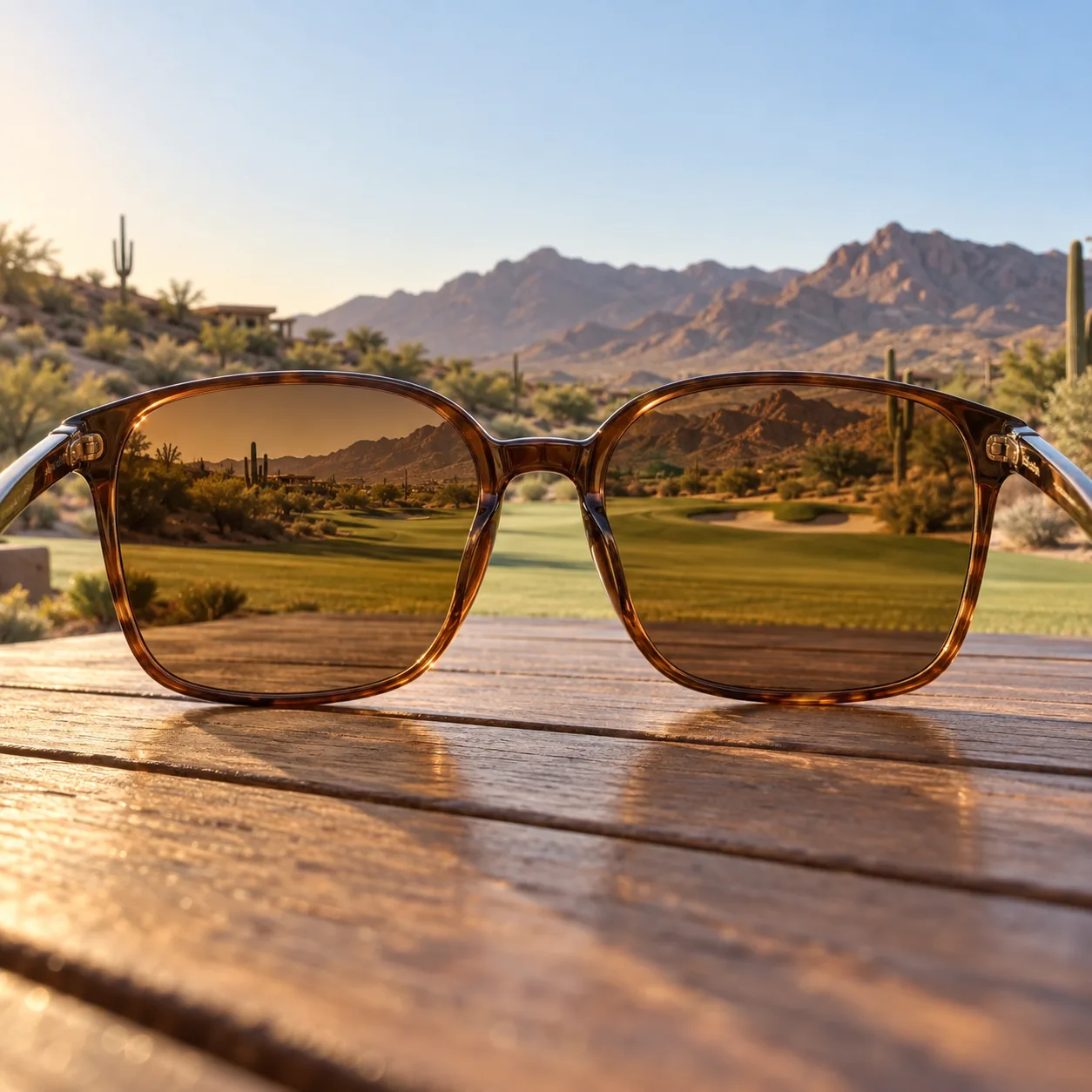
The sky scatters blue wavelengths of light, and grass reflects mostly green wavelengths. A warm-toned lens — amber, copper, brown, or the lighter rose/vermillion family — works by filtering out a large share of that blue light. Removing blue from the mix increases the relative contrast between a bright golf ball and both of those backgrounds, since the eye is no longer competing with as much blue-wavelength "noise" scattered across the scene.
This is a well-established principle in color science and sports-vision guidance, and it's the reason dark amber, copper, and brown lenses are consistently ranked among the top choices for discriminating shades of green — useful both for picking a ball out of the rough and for reading subtle contour on the green itself. Rose and vermillion tints apply the same principle with a lighter cast and higher visible-light transmission, which is why they tend to be favored in variable or partly cloudy conditions rather than full, bright sun.
Both, and it's worth being precise about which is which. The blue-light-filtering explanation above is sound optical reasoning grounded in how color and contrast work — but it isn't, by itself, a golf-specific clinical study. There is, however, real controlled research that speaks directly to the underlying visual task.
A study published through the American Academy of Optometry tested 33 subjects outdoors in natural sunlight at very high brightness levels (80,000 to 100,000 lux, comparable to a bright, sunny day), comparing clear lenses against an amber tint (50% visible-light transmission) and a gray-green tint (36% visible-light transmission). Both tinted lenses helped subjects recover usable vision after glare exposure roughly 15.5 seconds faster, on average, than clear lenses — and both produced close to a full line of improvement on a low-contrast visual acuity chart. That study wasn't conducted on a golf course, but the visual task it measured — recovering contrast sensitivity and reading low-contrast detail in bright outdoor light — is essentially the same task involved in tracking a ball against grass or a bright sky. It's honest to call this strong supporting evidence for tinted lenses in bright conditions, rather than a golf-specific clinical proof.
Not at all — they simply optimize for something different. Gray tints reduce overall brightness fairly evenly across all wavelengths, which means they preserve close to natural, true-to-life color perception. That makes gray an excellent all-purpose, versatile choice for general sun protection and comfort, but because it doesn't selectively filter any particular wavelength, it does less to specifically boost the contrast of a ball against grass compared with a warm tint.
Green tints sit in between the two: a moderate degree of contrast enhancement with a more neutral, true-color appearance than amber or brown. Sports-vision guidance is genuinely mixed here — some sources recommend green specifically for golf and baseball, while others rate warm ambers, browns, and rose tones as offering more contrast against grass specifically. This is an honest trade-off rather than a right-or-wrong answer, and personal preference for how "natural" the world looks through the lens plays a legitimate role in the decision.
Polarized lenses block horizontally reflected glare — the kind that bounces off wet grass, cart paths, and water hazards. That's a genuine, noticeable benefit mid-round, particularly on morning dew or after rain, and it reduces eye strain from squinting against bright reflected light.
The trade-off is that the same glare-cutting effect can mute some of the subtle sheen and shadow variation that certain golfers rely on to read the grain and slope of a green. Some golfers find that polarization actually helps them read greens more clearly by removing distracting glare; others feel it flattens the subtle visual cues they're used to reading. Neither preference is objectively correct — it depends on what you personally prioritize and how you've learned to read a green. If you're unsure, it's worth trying a round with and without polarization before committing to one lens type for good.
Rather than searching for one "best" tint to wear for life, the most practical approach is matching lens color to the conditions you're actually playing in. As a general guide: dark amber, copper, or brown for bright, sunny rounds; rose or vermillion for partly cloudy or variable light; a lighter yellow or amber for overcast skies or early-morning and dusk rounds, when boosting available light matters more than cutting it; and gray or green when accurate, true-to-life color judgment matters more to you than maximizing contrast.
If keeping track of multiple pairs for different conditions sounds impractical, photochromic lenses — lenses that automatically adjust their tint as ambient light changes — are a reasonable one-pair solution for a round where clouds roll in and out or the light shifts from the front nine to the back. Whatever you choose, the underlying eye health fundamentals still apply: proper UV protection, a comfortable and correct fit, and a comprehensive eye exam to make sure any lens you choose is paired with an accurate, up-to-date prescription.
See the Course More Clearly
Whether you're outfitting a new pair of prescription sunglasses for the course or want guidance on the right tint for your typical playing conditions, our optometrists and opticians can help you choose lenses that fit both your eyes and your game.