Sun & UV · 5 min read · Oct 22, 2026
Most of us reach for sunglasses because the light is bright and we're squinting. Comfort is a real benefit, but it isn't the most important one. Ultraviolet light builds up its effects on the eye quietly over years, and that cumulative exposure is linked to problems that reach all the way back to the retina. Here's what's actually happening inside the eye, and what to look for so your sunglasses are doing the job you're counting on them to do.
Beyond Comfort
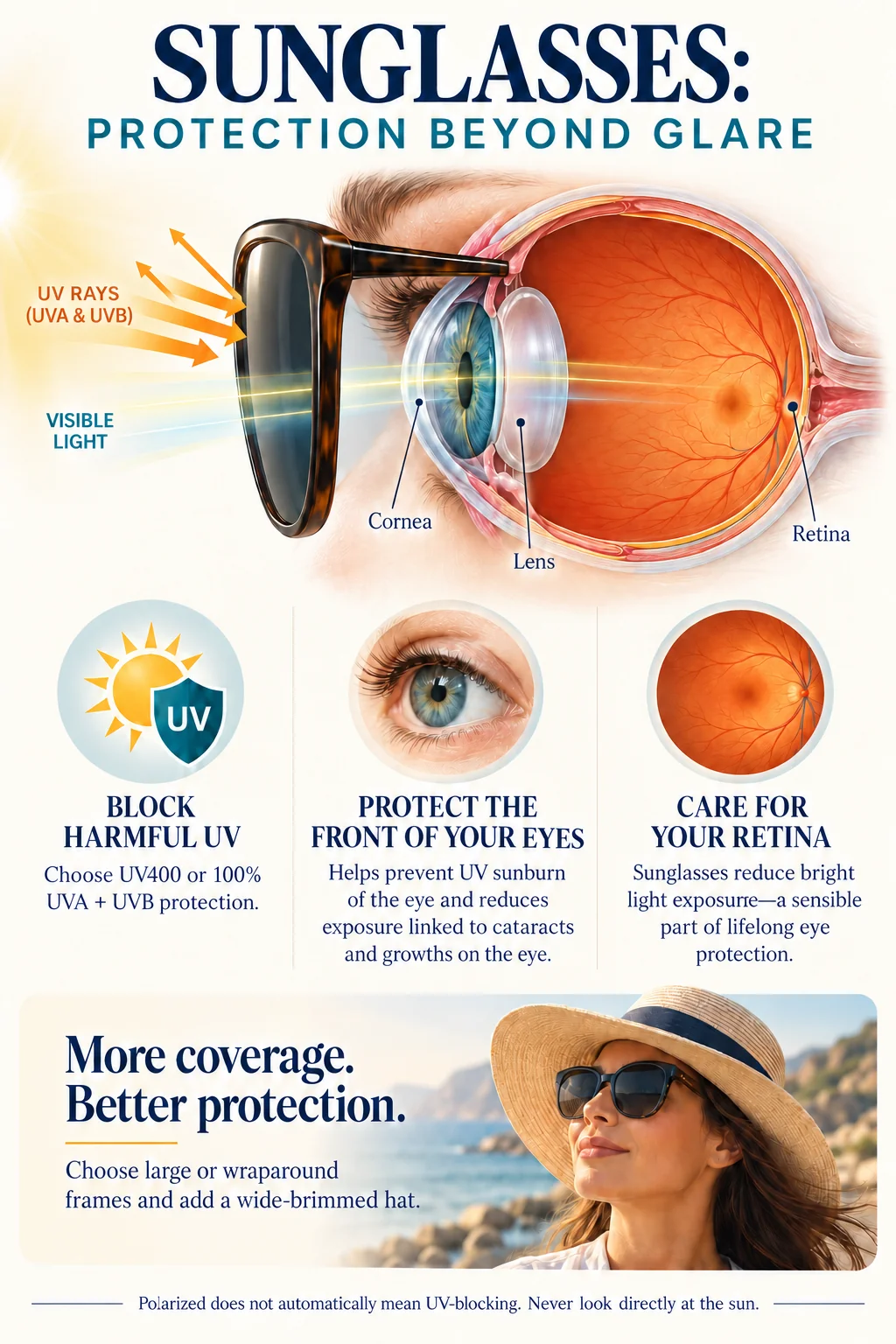
UV light isn't one thing, and it doesn't stop at the surface. UVB is absorbed mostly by the cornea at the very front of the eye, while UVA travels deeper, reaching the lens and, in part, the retina behind it. The concern for the retina and macula isn't heat. It's photochemical damage that adds up quietly with every unprotected hour outdoors. The American Macular Degeneration Foundation also notes that the eye's natural pigment, melanin, helps shield it from UV and blue light, but roughly half of that built-in protection is lost by age 65. That's one reason good habits matter more, not less, as we get older.
At a Glance
In This Article
According to the American Macular Degeneration Foundation, light can harm the retina in three ways: structural, thermal (heat), or photochemical. Which one happens depends on the wavelength, the intensity, and how long the eye is exposed. Everyday UV exposure falls mainly into the photochemical category. It's a slow chemical stress on eye tissue, not a burn, and it adds up over years rather than all at once.
The American Academy of Ophthalmology and the American Optometric Association both describe the same pattern. A single long day in the sun can cause short-term photokeratitis: red, gritty, light-sensitive, watery eyes that usually recover on their own. Repeated, unprotected exposure over many years is what's linked to the long-term problems: cataracts, pterygium, eye cancers, and macular degeneration.
It's linked to both, in two very different ways. The first is gradual. The American Optometric Association and the American Macular Degeneration Foundation both list long-term UV exposure as linked to age-related macular degeneration (AMD), alongside cataracts. Researchers describe UV as a risk factor for AMD, not the single cause. Genetics, age, and other factors play major roles, so sunglasses lower one risk rather than guaranteeing prevention. You may also have heard concerns about blue light from phones and computer screens. The American Macular Degeneration Foundation describes the evidence that screen blue light contributes to AMD as contradictory and inconclusive.
The second is sudden and separate: solar retinopathy. That's direct damage to the retina from looking straight at the sun or another intense light source, such as a solar eclipse, a welding torch, or a laser. The Cleveland Clinic notes that it doesn't hurt while it's happening. Symptoms such as blurred or distorted vision, blind spots, or light sensitivity can take hours or days to appear. Mild cases often improve within one to six months, but severe damage can be permanent. Wearing sunglasses outdoors helps, but no pair makes it safe to look directly at the sun.
The one standard all of these eye health organizations agree on is a label reading “UV400” or “100% UVA/UVB protection.” Check for that label rather than judging protection by how dark the lens looks or what the pair costs. The American Optometric Association also recommends that sunglasses screen out 75–90% of visible light, for comfort in bright conditions.
A few features add protection. Wraparound or larger frames help block UV that sneaks in from the sides during long stretches outdoors. Polycarbonate or Trivex lenses add impact resistance, which matters for golf, hiking, cycling, and other outdoor activity. For more on lens features like polarization, see our earlier guide to UV protection for your eyes.
Yes. The American Academy of Ophthalmology notes that UV rays pass through clouds and haze, so a gray sky doesn't mean your eyes are getting a break, and protection matters in every season, not just summer. UV also reflects off sand, water, and snow, which is why a day by the pool, on the lake, or on a ski trip can lead to photokeratitis even when the sun doesn't feel especially strong.
The simplest habit is to treat sunglasses like a seatbelt: put them on whenever you're outdoors for any length of time, whatever the weather looks like.
Children and teens tend to spend more time outdoors than adults, which is why the American Optometric Association specifically recommends UV protection for them too. Because UV damage is cumulative, the exposure a child gets now counts toward their lifetime total. The American Academy of Ophthalmology notes that pterygium, a UV-related growth on the eye's surface, can show up as early as the teens or twenties in people who spend long hours in midday sun or near water.
The good news is that the fix is simple: a well-fitting pair of UV400 sunglasses (impact-resistant polycarbonate or Trivex is a smart choice for active kids) and a brimmed hat when they're playing outside. Building the habit early is one of the easiest long-term investments in their eye health.
Protect Your Eyes for the Long Run
Our opticians can help you choose UV400 sunglasses, prescription or non-prescription, that fit well and suit your lifestyle. A comprehensive eye exam is also the best way to check the health of your retina and macula over time.